

Understanding Your Audience
Moving from labels to meaningful action.
Understanding Your Audience
Moving from labels to meaningful action.
Understanding your audience is one of the most frequently repeated principles in any marketing, communications and engagement strategy. It appears in strategy documents, campaign briefs and organisational plans. Teams invest in segmentation, personas and market research and entire presentations are dedicated to describing “who the audience is.”
Yet despite this attention, many organisations still struggle to connect meaningfully with the people they want to reach. The issue is rarely a lack of data; instead, the problem is that audience insight often remains surface level. Demographic categories are mistaken for understanding. Generational labels become shorthand for behaviour. Personas describe fictional individuals rather than revealing how real people actually make decisions.
As a result, communication can feel generic, strategies become overly complex and organisations find themselves asking the same question repeatedly:
Why isn’t our message landing?
True audience understanding goes far beyond labels. It requires curiosity about people’s lives, pressures, motivations and behaviour. It requires organisations to move from describing audiences to understanding how they experience the world. When this happens, communication becomes clearer, engagement becomes easier and strategy becomes more focused. Audience insight stops being a theoretical exercise and becomes a tool for making better decisions.
The Problem With Labels
For many organisations, the starting point for audience understanding is classification.
People are grouped into segments or generations:
Gen Z
Millennials
Gen X
Baby Boomers
These labels can provide useful context. Generations often share cultural reference points, economic experiences and technological shifts that shape broad attitudes. For example, younger audiences may be more comfortable navigating digital spaces and may expect immediacy and transparency in communication. Older audiences may place greater value on depth, reassurance and established relationships. These patterns can offer helpful perspective, but they are only a starting point.
The problem arises when generational thinking becomes a shortcut for understanding behaviour. Two people within the same generation may live very different lives. Their decisions may be shaped by completely different pressures, responsibilities and priorities, age alone rarely explains how people think or behave.
A generational label may tell you when someone was born but it does not tell you what they care about. Nor does it reveal what motivates them to engage, trust or act. If organisations rely too heavily on demographic shorthand, they risk designing strategies based on assumptions rather than insight. To understand audiences more deeply, organisations need to move beyond labels and explore the realities shaping people’s lives.
Context Shapes Behaviour
People do not engage with organisations in isolation, they engage within the context of their daily lives. Work pressures, financial uncertainty, family responsibilities, health concerns and personal aspirations all influence how people allocate their time and attention.
These contextual factors shape behaviour far more strongly than demographic labels. For example, two people may be the same age and share similar interests, yet their priorities may differ significantly if one is managing childcare responsibilities while the other is navigating career uncertainty. Life stage, economic circumstances and personal pressures all influence how people engage with information, make decisions and manage risk.
Context explains why audiences sometimes behave in ways that organisations find surprising. Someone may care deeply about an issue yet feel unable to engage due to time or financial constraints. Another individual may engage enthusiastically because the issue aligns closely with their personal experience or values. Understanding context helps organisations design strategies that recognise the realities people are navigating.
Instead of asking:
“What does this demographic want?”
A more useful question becomes
“What is shaping this person’s decisions right now?”
The answer often reveals barriers and motivations that demographic insight alone would never uncover.
Values Shape Meaning
If context explains the environment people are operating within, values explain what matters to them. Values act as a filter for attention and meaning, they influence what people notice, what they dismiss and what feels important enough to engage with. For some individuals, values may centre around responsibility, fairness and integrity, for others, independence, security, creativity or progress may be more important.
When communication aligns with someone’s values, it resonates naturally. When it does not, even the most carefully designed message can feel irrelevant. Values also play a central role in trust. In a world where audiences encounter constant information and persuasion, trust determines who people choose to listen to, it is rarely granted automatically. It develops through repeated experience.
People evaluate trust based on consistency, transparency and alignment with their values. Some audiences trust lived experience more than authority, others rely on expertise or institutional credibility. Some trust recommendations from peers more than formal messaging.
Organisations often assume trust because of their reputation, history or intention. Audiences decide trust based on behaviour. Understanding how trust operates for different audiences allows organisations to communicate more honestly and build stronger relationships over time.
Behaviour Reveals What Matters
While demographics describe audiences and values explain motivation, behaviour reveals what people actually prioritise. Behaviour provides observable evidence of engagement.
It shows:
What people pay attention to
What they ignore
When they act
When they hesitate
Patterns of behaviour often reveal insights that traditional segmentation cannot. Someone who appears to fit neatly into a demographic category may behave in ways that challenge assumptions. Conversely, individuals outside a target segment may become highly engaged supporters or customers.
Behaviour also highlights the difference between what people say and what they do. Survey responses may suggest strong interest in an issue or service. Actual behaviour may show hesitation or limited engagement. This gap is rarely irrational.
People make decisions in response to risk, uncertainty and competing priorities; understanding behaviour therefore requires empathy as well as analysis. Instead of simply observing behaviour, organisations should ask:
What concern might this behaviour be addressing?
What uncertainty might be influencing hesitation?
What reassurance might encourage action?
These questions move insight from observation to understanding.
From Insight to Action
Insight alone does not create impact, its value lies in the decisions it informs. Many organisations gather valuable audience insights but struggle to translate them into meaningful strategic change. Insight becomes trapped in reports or presentations rather than influencing day-to-day decisions. To avoid this, organisations need to connect audience understanding directly to action.
Instead of asking simply:
“What have we learned about our audience?”
A more powerful set of questions might include:
What should we prioritise differently?
What should we stop doing?
What should we change?
What should we simplify?
When insight informs decisions, strategy becomes clearer. Teams focus on the actions most likely to resonate with audiences rather than trying to reach everyone in the same way. Insight also needs to travel across organisations; audience understanding cannot sit solely within marketing or communications teams.
Product design, service delivery, fundraising and leadership decisions all benefit from understanding how audiences think and behave. When insight becomes shared understanding, it shapes organisational culture as well as strategy.
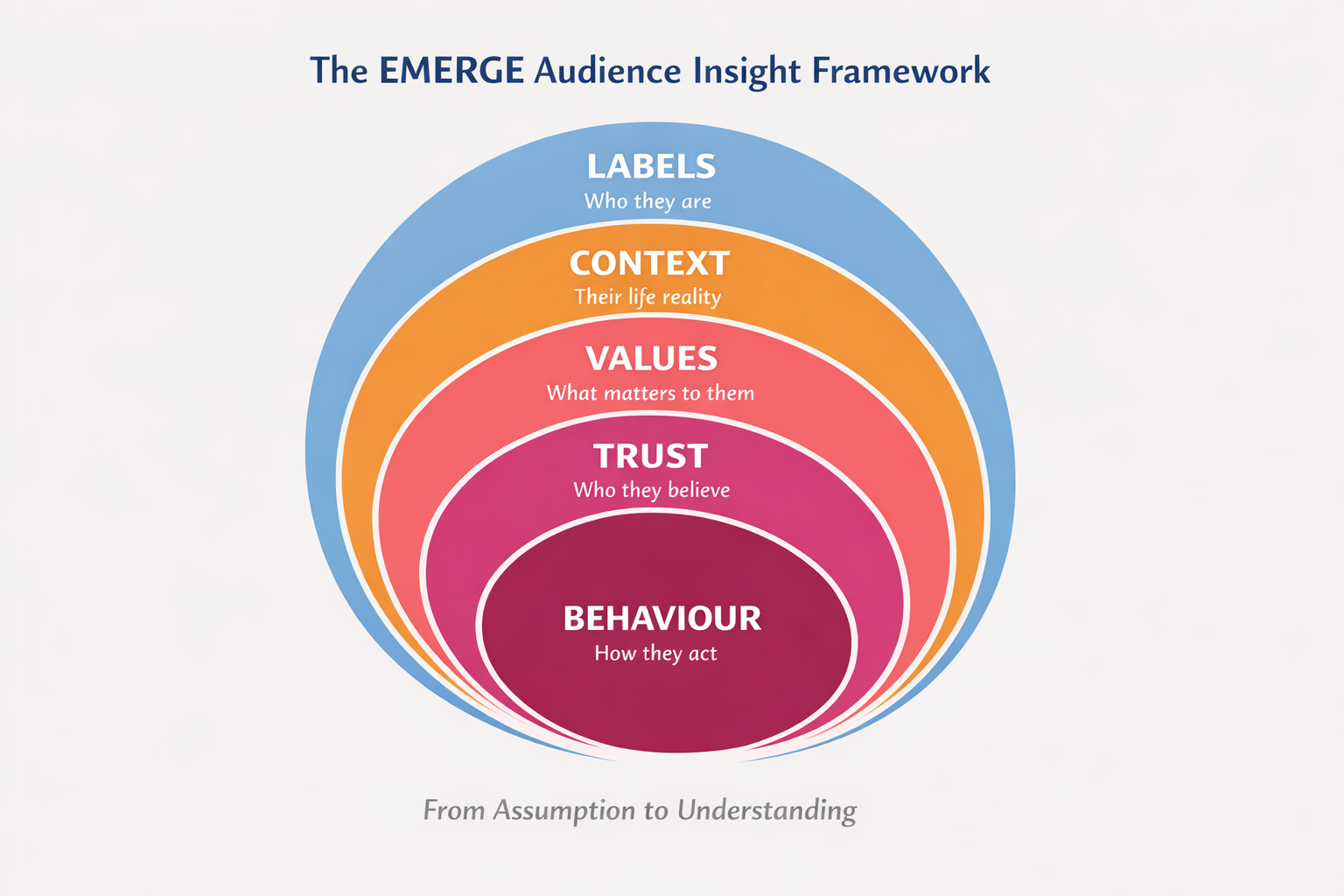
The EMERGE Audience Insight Framework
To help organisations move beyond surface-level segmentation, I’ve brought these ideas together through a simple lens for audience understanding; this framework highlights five layers that shape how people engage and make decisions.
1. Labels - Demographics and generational categories provide broad context about who audiences are.
2. Context - The realities of people’s lives — work, family, finances and responsibilities — influence how they prioritise attention and engagement.
3. Values - Personal beliefs and motivations shape what people care about and what feels meaningful.
4. Trust - Trust determines who audiences listen to and how credible communication feels.
5. Behaviour - Observed actions reveal what people actually prioritise and how they make decisions.
Each layer adds depth to understanding; when organisations rely solely on labels, insight remains shallow. When they explore context, values, trust and behaviour, far clearer picture emerges. This layered approach helps you move from assumption to understanding.
From Understanding to Connection
Audiences are often described as segments, markets or demographics, but in reality, audiences are individuals navigating complex lives. They manage competing priorities, evaluate risk, seek reassurance and make decisions based on a combination of context, values and experience.
When organisations recognise this complexity, communication changes and messages become clearer because they reflect real motivations. Strategies become more focused because they address genuine barriers and engagement becomes easier because organisations are meeting people where they are.
Understanding your audience is not simply about gathering more information, it’s about developing deeper curiosity about the people organisations aim to serve.
When that curiosity informs strategy, organisations move from speaking at audiences to connecting with them and meaningful connection is where lasting engagement begins.