Clarity Before Growth
Why Organisations need to slow down before the speed up.
Clarity Before Growth
Why Organisations Need to Slow Down Before They Speed Up
In many organisations, when something isn’t working, the instinctive response is simple: do more. More campaigns, more activity, more meetings and more urgency. Activity isn’t the same as progress and when clarity is missing, doing more rarely solves the problem.
In fact, many organisations aren’t struggling because they lack effort. They’re struggling because they’ve moved too quickly past the foundational questions that make good strategy possible.
Before the campaign, before the channels and before the creative idea, there is quieter work that matters far more. Clarity.
The Question Organisations Forget to Ask
Spend time with a toddler and you’ll notice something remarkable about how they explore the world. They ask the same question over and over again:
Why?
Why does it work like that? Why does that happen? Why does it matter? Somewhere along the way, organisations lose this instinct. Strategies are written, campaigns are launched, activity increases and yet the most important question is often left unspoken:
Why should anyone care?
When engagement drops, attention is usually blamed. Audiences are distracted, digital channels are crowded and competition is increasing; but attention is rarely the real issue. More often, the challenge is relevance. If audiences don’t understand why something matters to them, more communication simply creates more noise. The organisations that cut through are rarely those that communicate the most. They are the ones that communicate with the greatest clarity about why their work matters.
When Activity Replaces Impact
When clarity is missing, organisations rarely slow down. They speed up, new initiatives are launched, more campaigns are created, more reporting is introduced.
From the outside, the organisation appears productive, Inside, however, something else begins to happen. Teams become stretched, priorities become blurred and decision-making slows down.
The result is a familiar pattern:
Strategy becomes unclear
Activity increases to compensate
Teams feel increasing pressure
Impact becomes harder to measure
Work continues, but momentum fades. The issue is not capability or effort, it’s direction. Without a shared understanding of what matters most, organisations become busy but not necessarily effective.
The Cost of Unclear Direction
Clarity is often framed as a strategic issue, but its effects are deeply cultural. When priorities are unclear, people feel it long before it appears in a strategy document.
Teams begin asking questions like:
What matters most right now?
Which project should take priority?
What does success actually look like?
Without clear answers, individuals begin making their own assumptions.
Over time this leads to subtle but powerful organisational challenges:
Teams moving in different directions
Projects competing for attention
Decision-making becoming slower and more cautious
Confidence in leadership gradually weakening
When clarity exists, the opposite happens. People move faster because they understand the direction, teams collaborate more easily because priorities are shared and decisions become simpler because success is defined. Clarity is not simply a strategic tool, it’s a cultural stabiliser.
Returning to the Questions That Matter
Before strategy becomes execution, organisations need to revisit a set of deceptively simple questions.
What are we actually trying to do?Many initiatives begin with activity rather than purpose, clarifying the core idea forces organisations to define what they are really creating.
Why does this matter? This question moves beyond internal priorities and asks what difference the work makes in the real world.
Why now? Timing is often the missing piece of strategy. understanding why an initiative matters today strengthens its relevance.
Who is it really for? Not every initiative is for everyone, strategic clarity often emerges when organisations identify their most important audiences.
Where will people encounter it? Experience matters and strategy must consider where and how audiences engage with the organisation.
How will it come to life? This is where strategy begins translating into reality — through experiences, communication and action.
These questions may appear basic, but they often reveal the assumptions hidden beneath organisational plans. When they are answered clearly, everything else becomes easier.
The Role of Audience Understanding
At the centre of meaningful strategy sits a single, essential question:
Who is this really for?
Many organisations start with what they want to say, but meaningful engagement begins with understanding the people they want to reach.
Not simply in demographic terms, but at a deeper level:
What motivates them
What challenges they face
What they care about
What influences their decisions
When organisations reconnect their work with the lives and priorities of their audiences, communication becomes far more powerful. The goal is not to change who the organisation is, it’s to express its purpose in ways that resonate with the people it hopes to serve.
Strategy Only Works If People Can Carry It
Even when organisations do the hard work of developing a strategy, another challenge often emerges. The strategy exists — but it doesn’t travel. It lives in planning documents, presentations or leadership discussions, but it rarely shapes day-to-day behaviour. If people cannot explain a strategy in simple terms, it is unlikely to guide their decisions. This is where storytelling becomes critical.
Story does not replace strategy, it carries it. When strategy becomes a narrative — something people can understand, repeat and connect to their own work — it starts to move through the organisation. It shapes conversations, it influences priorities and it guides behaviour. Without this translation, strategy risks remaining theoretical rather than operational.
Clarity Enables Growth
In fast-moving organisations, stepping back can feel uncomfortable. There is constant pressure to deliver, launch and scale. But clarity does not slow organisations down, it allows them to move forward with confidence.
When clarity exist, priorities become sharper, teams align around shared goals, communication becomes more focused, decision-making accelerates and impact becomes visible. Growth built without clarity often places pressure on people and culture. Growth built on clarity creates momentum.
The Quiet Work Behind Effective Organisations
Strategy often focuses on visible outputs: campaigns, programmes, initiatives and launches. But the most valuable work frequently happens earlier, and more quietly. It happens in the questions organisations ask before the work begins. Taking time to explore these questions and seeking the clarity need forms the foundation of a meaningful strategy.
And sometimes, the best way to rediscover them is to borrow the mindset of a curious toddler — and start asking why again.
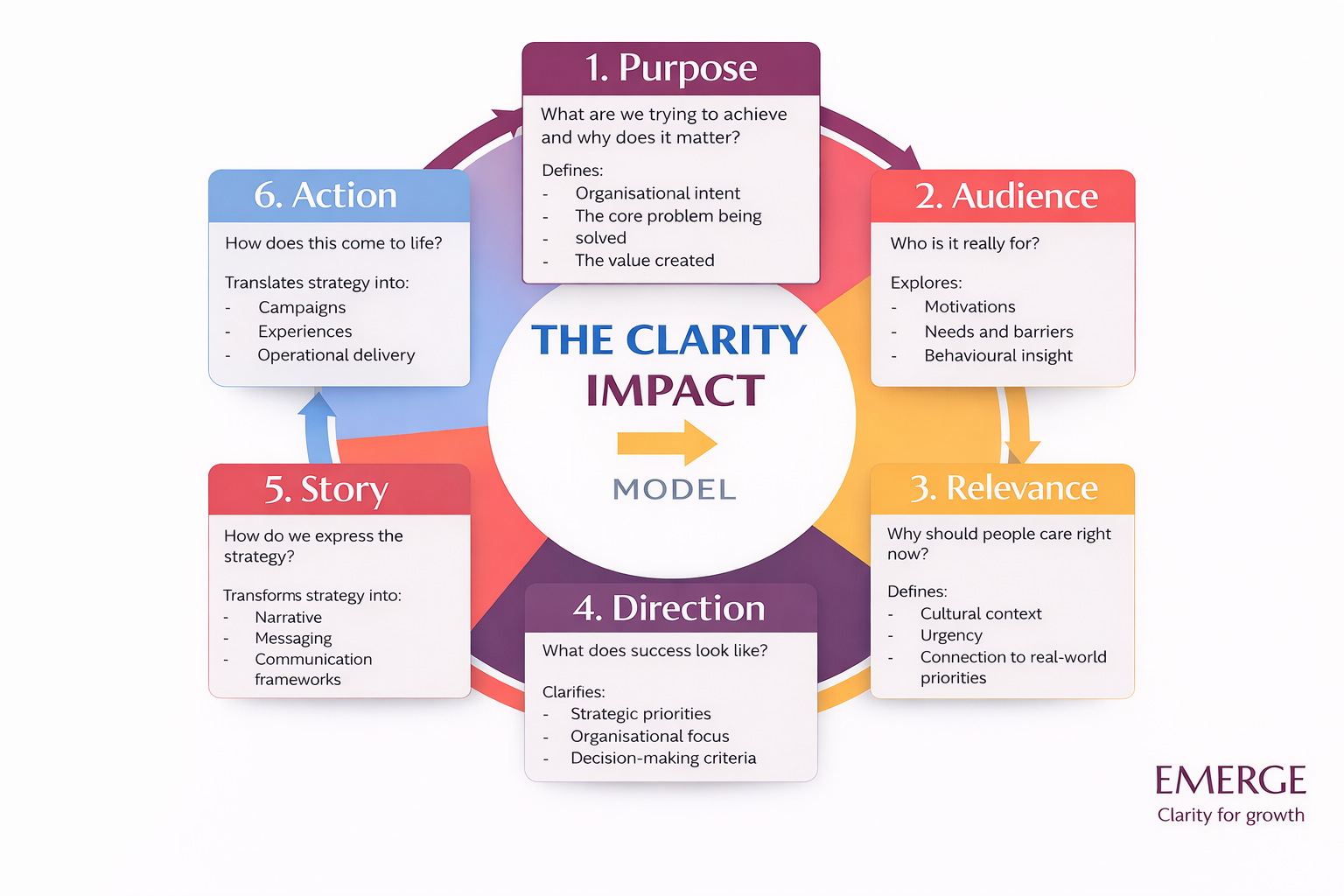
The Clarity to Impact Model
The above thinking has been distilled into Clarity to Impact Model is a simple framework designed to help organisations step back and reconnect the key elements that drive meaningful impact.
It maps the journey from purpose to action — ensuring that strategy is grounded in audience insight, shaped by relevance and translated into stories and experiences people can connect with.
Because when clarity comes first, impact follows.