

Commercial Clarity
The discipline behind sustainable growth
Commercial Clarity
The discipline behind sustainable growth
Marketing is often judged by visibility - reach/engagement/awareness. But visibility alone does not create growth; at best, it creates attention - at worst, it becomes expensive theatre. Bringing commercial clarity to the fore asks the question;
How does this activity contribute to sustainable growth?
When you adopt this mindset, marketing stops being measured by activity and starts being evaluated by contribution. That shift changes how decisions are made, how teams collaborate, and ultimately how organisations grow.
The Separation Problem
In many organisations, marketing and commercial strategy sit beside each other rather than working together.
Marketing teams often focus on:
Messaging
Campaigns
Channels
Creative execution
Commercial teams focus on:
Revenue
Margin
Forecasts
Pipeline
When these perspectives operate independently, friction emerges. Marketing may generate attention that doesn’t convert and conversely Commercial teams may prioritise short-term revenue that undermines long-term brand trust. The result is a familiar tension — and inconsistent growth.
Commercial clarity begins by closing this gap, ensuring that marketing decisions and commercial outcomes are connected from the outset.
Contribution Over Performance
Many marketing metrics appear impressive but say little about commercial impact. High traffic does not equal revenue and high engagement does not equal demand. Commercial clarity shifts the conversation from performance to contribution.
Organisations begin asking more meaningful questions:
What proportion of revenue is influenced by marketing?
What does acquisition cost look like relative to lifetime value?
Where are we leaking margin in the funnel?
Without these conversations, marketing becomes easy to reduce during budget pressure because its commercial value is unclear. When contribution is understood, marketing becomes something very different: a strategic growth lever.
Forecasting Creates Strategic Focus
Forecasting is often treated as a finance function. In reality, it is one of the most powerful tools for creating marketing clarity.
Effective forecasting forces teams to articulate:
Expected demand
Conversion assumptions
Revenue contribution
Required investment
Instead of reacting to results after campaigns launch, teams begin designing activity with commercial outcomes in mind.
Forecasting also introduces structured thinking:
How many leads are required?
At what conversion rate?
At what cost?
To deliver what revenue outcome?
These questions do not restrict creativity. They focus it. Strong organisations also use scenario planning:
Conservative case
Expected case
Stretch case
This approach reduces reactive decision-making and allows leaders to adjust investment with intention rather than panic.
Aligning Brand, ESG (Environmental, Social and Governance) and Revenue
Another barrier to commercial clarity appears in organisations that separate purpose and profit. Brand values and ESG commitments are often communicated clearly in campaigns but remain disconnected from commercial decision-making.
Values appear in messaging but not in:
Product design
Pricing strategy
Customer experience
Investment priorities
When this happens, audiences quickly detect the inconsistency and purpose begins to feel performative. True alignment requires a different approach. Organisations must ask:
How does this value influence our decisions?
Does our pricing reflect our positioning?
Are we investing in what we claim to prioritise?
When brand, ESG and commercial strategy reinforce each other, something powerful happens: messaging becomes simpler, trust strengthens and differentiation becomes clearer. Revenue then becomes evidence of alignment rather than a contradiction of values.
Marketing as an Investment, Not a Cost
Language matters; when marketing is described as a cost centre, it is scrutinised as an expense. When marketing is described as an investment, it is evaluated for its return. That distinction shapes behaviour.
Cost-focused organisations tend to prioritise:
Short-term optimisation
Budget reductions under pressure
Risk aversion
Investment-focused organisations think differently.
They invest in:
Brand equity
Customer relationships
Capability development
Long-term demand generation
To support this shift, organisations need visibility of key commercial indicators:
Customer acquisition cost
Lifetime value
Retention rates
Contribution margin
When these metrics are clear, marketing can demonstrate its value confidently — including at board level.
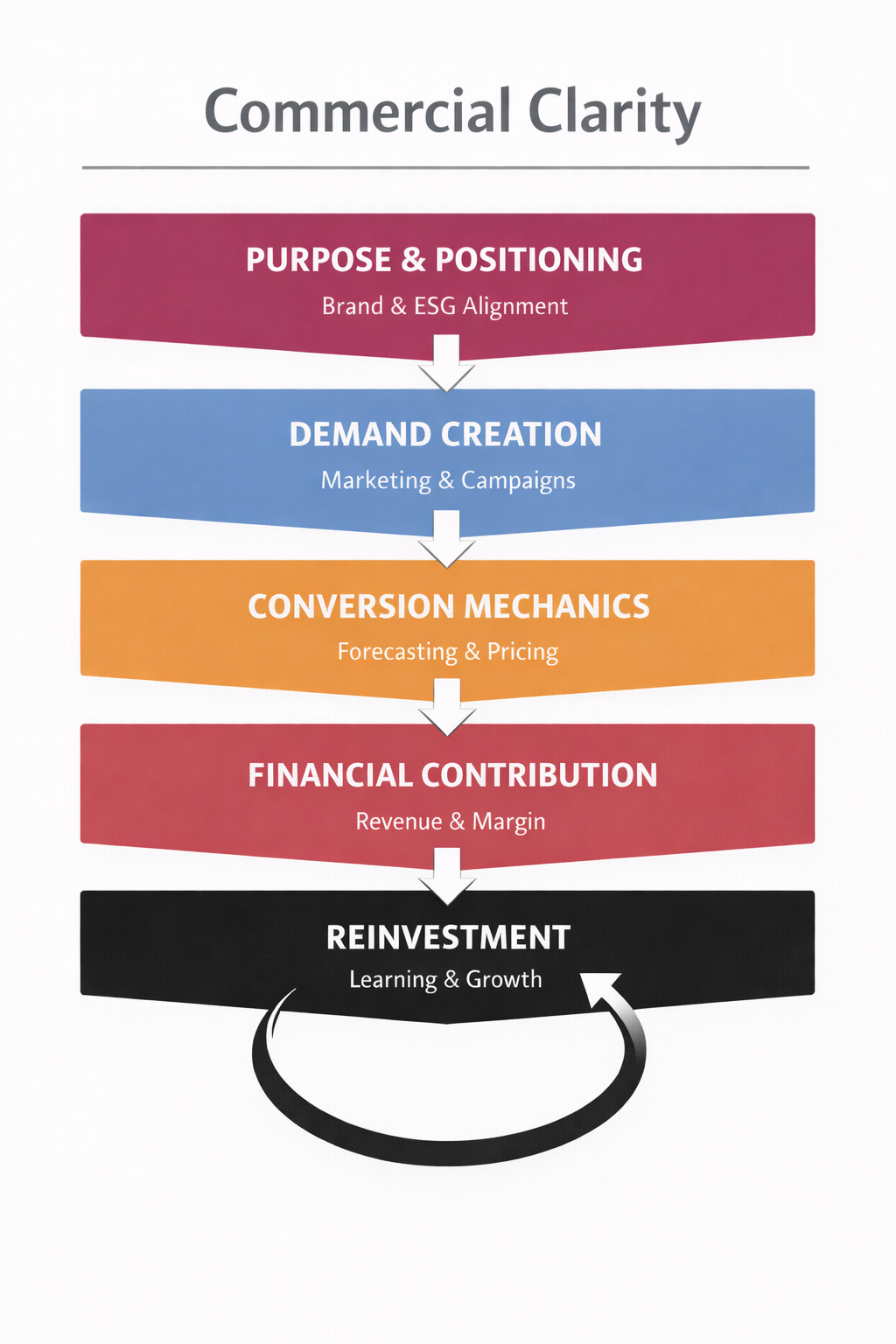
For all of the visual thinkers and learners, the above thinking has been distilled into the below commercial clarity visual.
Growth becomes sustainable when purpose, marketing and commercial strategy operate as one system.
Break any connection in this chain and clarity disappears.
The Discipline Behind Growth
Commercial clarity introduces constraint, it forces difficult conversations about:
ROI
trade-offs
priorities
accountability
That discomfort is precisely why it works - constraint sharpens thinking, campaigns become more deliberate, investment decisions become more strategic and messaging becomes aligned with conversion, not just attention.
Commercial clarity does not restrict creativity. It directs it toward outcomes that actually matter and when that discipline becomes embedded, marketing stops being an activity. It becomes a driver of sustainable growth.