The Power & Limitations of AI
The Power & Limitations of AI
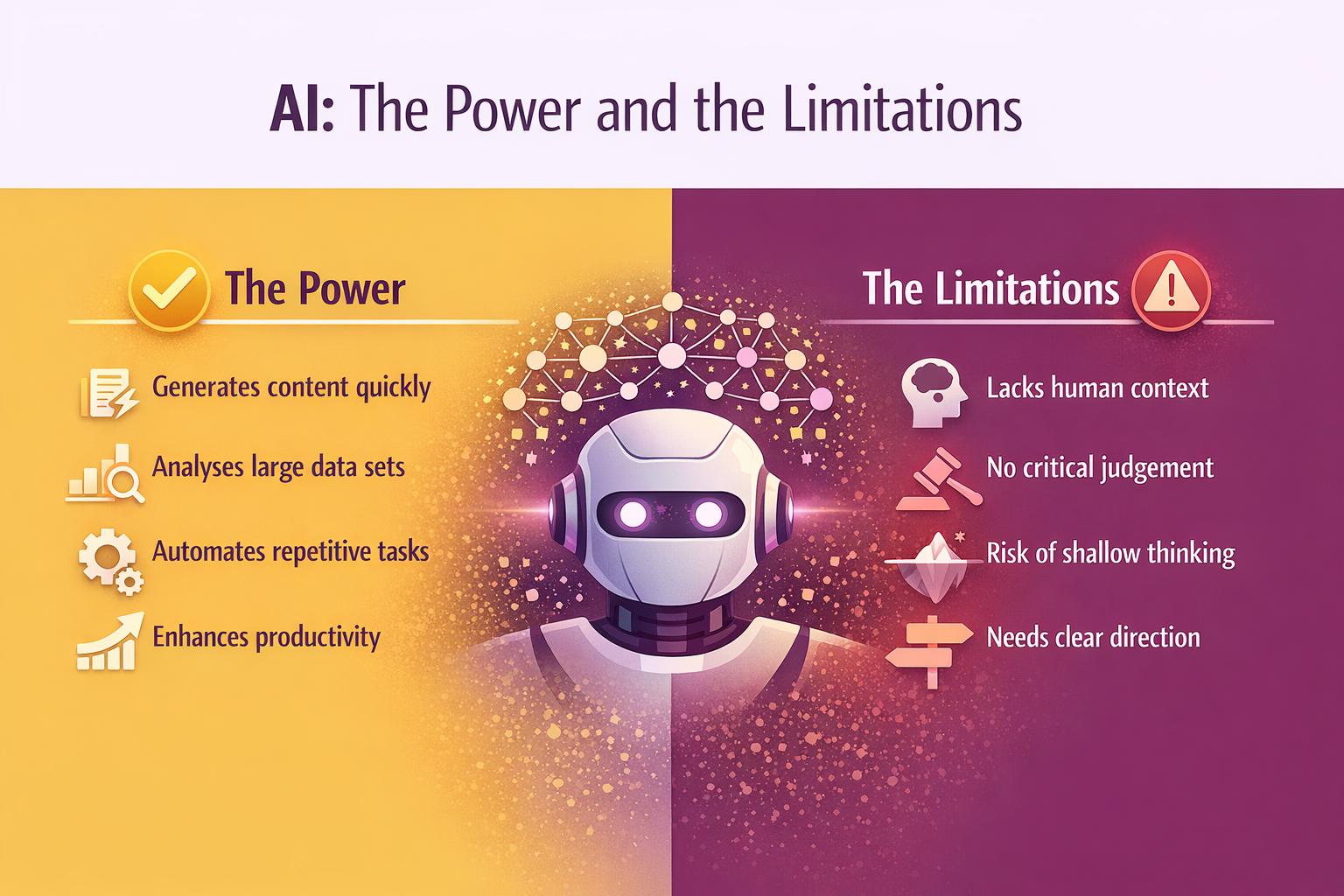
Artificial intelligence is rapidly becoming part of how organisations think, work and make decisions. From generating content to analysing data, AI offers speed, scale and efficiency that would have been difficult to imagine even a few years ago. It can surface patterns, accelerate processes and support decision-making in ways that fundamentally change how work gets done. The potential is significant, but so are the limitations.
AI amplifies what already exists
AI is often presented as a transformative force and in so many ways, it is. But its impact is rarely independent of the organisation using it.
AI does not create clarity, it works with the clarity that already exists. If an organisation has a strong strategic foundation, clear priorities and a deep understanding of its audiences, AI can enhance and accelerate that work. It can help teams move faster, test ideas more efficiently and operate at greater scale. However, if those foundations are unclear, AI tends to amplify the problem. It can generate more content, more ideas and more activity — but without direction, this often leads to noise rather than impact.
Speed is not the same as effectiveness
One of AI’s greatest strengths is speed. Tasks that once took hours can now be completed in minutes. Content can be generated quickly, data can be processed instantly and outputs can be scaled with ease. But speed does not guarantee effectiveness Without clear strategic intent, faster output simply means reaching the wrong audience, with the wrong message, more quickly. In this sense, AI highlights an existing truth: efficiency only matters when it is applied in the right direction.
AI lacks context and judgement
AI is highly capable of recognising patterns and generating responses based on data. But it does not fully understand context in the way humans do.
It cannot experience organisational dynamics, it cannot interpret nuance in the same way and it cannot apply judgement shaped by lived experience. This matters most in complex environments.
Strategy, leadership and organisational decision-making often rely on ambiguity, interpretation and trade-offs. These are areas where human judgement remains essential. AI can support thinking, but it cannot replace it.
The risk of replacing thinking with output
As AI becomes more embedded in day-to-day work, there is a risk that organisations begin to prioritise output over thinking. When content, ideas and analysis can be generated instantly, it becomes easier to move quickly without fully engaging with the underlying questions. This can create a false sense of progress, work is produced and activity increases. But the quality of thinking may not improve at the same pace; over time, this can weaken strategic clarity rather than strengthen it.
Where AI creates real value
AI is most powerful when it is used to support clear thinking, not replace it.
It can help organisations:
Explore ideas more quickly
Synthesise large volumes of information
Test different approaches at speed
Reduce time spent on repetitive tasks
Used in this way, AI creates space; space for deeper thinking, for better decisions and space for more meaningful work.
A tool, not a strategy
AI is a tool. Like any tool, its value depends on how and where it is used.
Organisations that see AI as a shortcut to better outcomes may be disappointed. Those that integrate it into a clear strategic approach are more likely to realise its potential. The difference is not the technology itself, it is the clarity of thinking behind it.
A simple way to think about it
AI accelerates, have clarity directs it, audience understanding grounds it and strategy decides outcomes.
Without these, acceleration rarely leads where it should.